Learn Arabic for Beginners: From Letters to Real Conversations
- Posted by Aya Wahab
- Date October 5, 2025
Learning Arabic may feel intimidating at first. The letters look new, the script goes right to left, and some sounds don’t exist in English. But don’t worry, Arabic becomes much easier when broken down step by step.
Beyond words, Arabic is a gateway to connect with people, enjoying travel, and opening career opportunities. If you’ve ever wondered, “Where do I start learning Arabic?” this guide will take you from the alphabet to full conversations.
Table of Contents
Toggle1. Mastering the Arabic Alphabet
Arabic has 28 letters, which connect depending on their position in a word—beginning, middle, end, or alone. Some letters look similar, and dots are key:
Letter – Name – Dots
- ب – baa – 1
- ت – taa – 2
- ث – thaa – 3
Tip: Train your eyes to notice dots early, it makes reading much easier.
2. Conquering Pronunciation
Arabic has sounds unfamiliar to English speakers. Focus on mouth and throat positions:
- ع (ayn): Tighten your throat slightly.
- ح (haa): A strong, airy “h.”
Practice in front of a mirror and repeat out loud. Correct pronunciation changes meaning and improves understanding.
3. Short Vowels (Harakat) – Reading Words
Arabic uses short vowels to guide pronunciation:
Vowel – Symbol – Sound
- Fatha – ـَـ – a
- Kasra – ـِـ – i
- Damma – ـُـ – u
Example: كتب
- kataba = he wrote
- kutiba = it was written
- kitab = book
Mastering these marks lets you read full words and simple sentences quickly.
4. Build Your First Vocabulary
Start with 50 essential words:
- Nouns: بيت (house), كتاب (book)
- Verbs: ذهب (to go), كتب (to write)
- Adjectives: كبير (big), صغير (small)
Tip: Speak, write, and review often. Spaced repetition moves words from memory into natural use.
5. Grammar Made Simple
Arabic words often come from three-letter roots, helping you expand vocabulary efficiently:
Root – Derived Words
ك ت ب – كتاب (book), مكتب (office), كاتب (writer)
Sentence structures:
- Nominal: Subject first
- Verbal: Verb first
- Gender: Nouns and adjectives are masculine or feminine
6. Survival Phrases from Day One
Start speaking Arabic immediately:
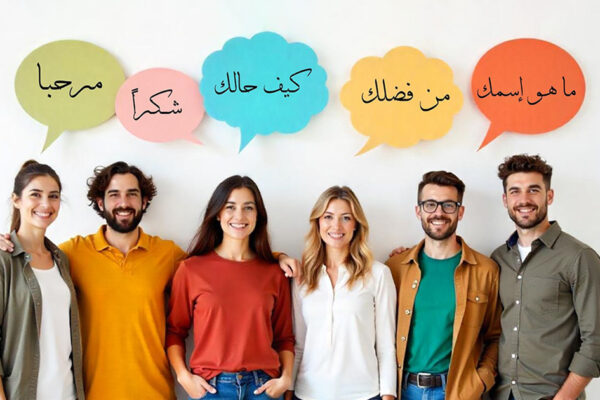
- Greetings: Marhaba (Hello)
- Introduction: Kayfa haluk? (How are you?)
- Politeness: Shukran (Thank you)
Simple questions for daily use:
- Ayna…? (Where is…?)
- Kam / bikam? (How much?)
- Hal tatahadath al-ingliziya? (Do you speak English?)
Use these in shops, cafes, or when asking for directions.
7. Practice Conversations
Listening: Start with slow, clear audio for beginners. Gradually move to children’s shows or slow news podcasts.
Speaking: Shadow native speakers by repeating phrases aloud. Practice daily, even alone.
Dialogue: Combine letters, words, grammar, and phrases to create small conversations:
- Introducing yourself
- Ordering food
- Asking for directions
Add follow-up questions like: “Where are you from?” or “Do you like this?” to keep conversations flowing naturally.
8. Build a Sustainable Learning Habit
Consistency beats long study sessions.
- Practice 15 minutes daily across reading, writing, listening, and speaking.
- Stick to one path: Modern Standard Arabic first, then a dialect.
- Real conversations matter more than drills.
9. When to Seek Professional Guidance
Self-study works, but a structured class accelerates progress. Teachers correct mistakes instantly and guide you efficiently. At AlBaher Arabic Language Center, our beginner lessons make learning practical, enjoyable, and fast.
Start Your Arabic Journey Today
Learning Arabic is about steady, consistent steps:
Alphabet → vowels → words → grammar → phrases → conversations
Practice daily, focus on communication, and enjoy real-life interactions
With the right approach and support, you’ll go from single letters to full conversations faster than you think.
FAQ
- Alphabet: a few weeks
- Short conversations: 3–6 months
- Fluency: steady effort over time
Alphabet, script, and pronunciation
Start with Modern Standard Arabic; add a dialect later
Few shared words, but grammar, script, and sounds differ
Yes, but step-by-step practice and patience lead to strong progress
If you focus on the Levantine dialect, you can start handling basic social interactions—like introducing yourself, ordering food, and asking for directions—within just 4 to 6 weeks. While total fluency takes time, the “Social ROI” of the Shami dialect is very high. At AlBaher, we prioritize high-frequency “survival” phrases that get you talking to locals immediately, which in turn accelerates your learning through real-world practice.
While you can use transliteration (Arabic words written in English letters) for the first few days, we strongly recommend learning the script early on. The Arabic alphabet is phonetic and highly logical. Learning it allows you to see the “roots” of the words you are speaking, which helps you memorize vocabulary much faster. Once you “decode” the script, the entire city of Amman becomes your textbook.
Arabic is often categorized as a “Category IV” language, meaning it takes more time to master than Spanish or French. However, this is largely due to the new script and unique throat sounds. The Levantine dialect actually simplifies many of the complex grammar rules found in formal Arabic, making the “speaking” part much easier for beginners. With the right mindset and a focus on the dialect, the “difficulty” is often replaced by a sense of discovery.
Yes, you can. This is a popular choice for travelers and expats who want “functional” skills. However, at AlBaher, we suggest an Integrated Path. Learning a tiny bit of formal Arabic alongside the dialect helps you read menus, signs, and official documents, while the dialect gives you the warmth needed for conversation. This dual approach ensures you aren’t “literate but silent” or “fluent but illiterate.”
To win hearts in the Levant, start with these:
- Marhaba: A simple, warm “Hello.”
- Ya’teek el-afiye: A beautiful phrase used to thank someone for their work/effort.
- Shukran jazilan: “Thank you very much.”
- Min fadlak / fadlik: “Please” (masculine/feminine).
- Forsa sa’ideh: “Nice to meet you” (literally: a happy opportunity). Using these shows you aren’t just a visitor, but someone who respects the local culture.

You may also like

Learn Levantine Arabic Online or in Amman

Arabic Language Dialects: A Guide to Different Arabic Dialects