
Speak Like a Local: How Levantine Arabic Unlocks Real Connections in the Middle East
- Posted by Aya Wahab
- Date October 12, 2025
You might know perfect Modern Standard Arabic (Fusha), but could you order a coffee in Amman without hesitation? Surprising as it sounds, Fusha is mostly for news, books, and formal speeches. Everyday life in Jordan, Lebanon, Palestine, and Syria runs on Levantine Arabic.
Whether you want to buy bread, ask for directions, or chat with a neighbor, Levantine Arabic is the language that opens doors to real connections. And here’s the exciting part: you don’t need to be fluent to make an impact. Even a handful of survival phrases can earn respect, smiles, and authentic interactions.
Table of Contents
Toggle1. Basic Greetings That Locals Use Every Day
First impressions matter. A simple greeting in Levantine Arabic can set the tone for your entire interaction. Here’s how to get it right:
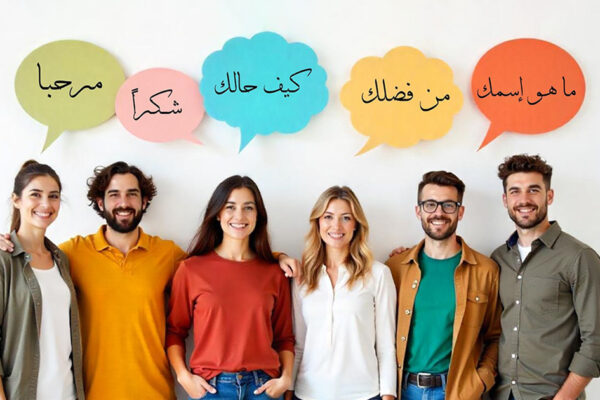
- “Marhaba” (مرحبا) – Welcome / Hello
The most common and friendly greeting. Use it anytime you meet someone.
- “Kifak?” (كيفك؟) / “Kifik?” (كيفكِ؟) – How are you?
Kifak = masculine
Kifik = feminine
- “Al-hamdu lillah” (الحمد لله) – Praise be to God / I’m well
Even if life isn’t perfect, this positive phrase signals gratitude and politeness.
Politeness matters:
- “Min fadlak” (من فضلك) / “Min fadlik” (من فضلكِ) – Please
- “Shukran” (شكراً) – Thank you
Quick conversation tip:
- “Marhaba – Kifak/Kifik – Al-hamdu lillah”
Just three phrases, yet powerful enough to open doors to kindness.
2. Essential Phrases for Taxis & Directions
Navigating a new city becomes effortless with a few key phrases:
- “Biddi awsal ala…” (بدي أوصل على…) – I want to go to…
Example: “Biddi awsal ala al-madina” = “I want to go to the city.”
- “Bi’iddesh at-tawsila?” (بقديش التوصيلة؟) – How much is the fare?
- “Ayna…?” (أين…؟) – Where is…?
Example: “Ayna al-hammam?” = “Where is the bathroom?”
Pro tip: Repeat phrases aloud five times to get the rhythm—they’ll roll off your tongue naturally.
3. Ordering Food & Dining Out
Ordering in Levantine Arabic makes meals more enjoyable—and locals appreciate it!
- “Biddi…” (بدي…) – I want…
Example: “Biddi manaqeesh” = “I want manaqeesh.”
- “Law samaht” (لو سمحت) – If you please (polite attention-getter)
- “Al-fatura, law samaht” (الفاتورة لو سمحت) – The bill, please
- “Haadha lateem!” (هذا لذيذ!) – This is delicious!
Tip: Saying a word or two in Levantine Arabic while ordering makes your meal memorable—for both you and the waiter.
4. Shopping & Bargaining in the Souk
Souks are colorful, vibrant, and full of life. Bargaining is expected, not rude. Use these phrases:
- “Bi’iddesh?” (بقديش؟) – How much?
- “Ghali kteer” (غالي كتير) – Too expensive
- “Btakhtasir?” (بتختصر؟) – Can you lower it?
Smile and pause after asking “Bi’iddesh?”—many vendors offer a better price immediately!
5. Emergency Phrases You Must Know
Traveling is fun, but being prepared is crucial. Keep these phrases handy:
- “El-musaada!” (المساعدة!) – Help!
- “Ana dayye’ / Ana dayy’a” (أنا ضايع / أنا ضايعة) – I’m lost (masc/fem)
- “Biddi doctor” (بدي دكتور) – I need a doctor
Keep these phrases in your phone or a small card—you never know when they might save the day.
Start Speaking Levantine Arabic Today
Learning Levantine Arabic isn’t about memorizing hundreds of words—it’s about connection. A greeting, a polite question, or a kind phrase makes locals feel respected. That respect often turns into smiles, kindness, and stories you’d never hear otherwise.
Ready to go beyond “Marhaba”? At AlBaher Arabic Language Center, we’ll help you learn Levantine Arabic confidently, so you can enjoy real conversations and unforgettable experiences across the Middle East.
Take the first step: Enroll in our Levantine Arabic courses today!
FAQ
The secret to sounding like a local isn’t just vocabulary; it’s the “connectors.” Use “Ya’teek el-afiye” (May God give you health) when greeting anyone working—from a taxi driver to a shopkeeper. It is the most respected “hello” in the region. Pair this with “Tayyeb” (Okay/Good) and “Ya’ni” (I mean/Like) to fill the gaps in your speech. These small words provide the rhythmic “flow” that makes your Arabic sound authentic rather than robotic.
Hospitality in the Levant is a choreographed art. If you are offered food or coffee, use the phrase “Sahtain” (Double health) when others eat, and respond with “Aala albak” (To your heart). If someone does you a favor, instead of a simple “thanks,” say “Tislam Ideik” (May your hands be saved). These phrases acknowledge the person’s effort and create an immediate emotional bond that transcends basic translation.
In the Levant, phrases like “Inshallah” (God willing), “Mashallah” (What God has willed), and “Alhamdulillah” (Praise be to God) have become cultural “punctuation marks” used by both Christians and Muslims. They aren’t always strictly religious; they are ways to express hope, protection against envy, or general contentment. Learning to use them in the right context shows that you understand the cultural “fabric” of the region.
Absolutely. Jordanians are famously proud of their language and hospitality. When a foreigner makes the effort to use a specific Levantine idiom like “Walaw!” (Not at all / Don’t mention it) or “Aala rasi” (On my head / With pleasure), it signals that you respect the local identity. This effort often leads to better service, deeper conversations, and invitations to share a meal that “textbook-only” speakers might miss.
The Levant is a “high-context” culture where a direct “No” can sometimes feel harsh. To decline politely, use “Mamnounak” (I am grateful to you) or “Ghair marra, inshallah” (Another time, God willing). If you are in the market and a price is too high, use the friendly “Ktir heik, ya m’allem” (That’s too much, boss) with a smile. It keeps the interaction light and respectful while clearly stating your boundary.

You may also like

Learn Levantine Arabic Online or in Amman

Arabic Language Dialects: A Guide to Different Arabic Dialects