
Can We Consider the Different Arabic Dialects As Languages?
- Posted by EDU Admin
- Date January 8, 2023
Arabic is often thought of as a single language. Yet if you travel from Morocco to Iraq, you’ll quickly notice that what people speak in daily life—called spoken dialects—can vary so greatly that native speakers from different regions may struggle to understand each other. This raises a central question: Are Arabic dialects separate languages, or simply varieties of the same language?
Let’s explore the answer through linguistics, real-world communication, and how Arabic is taught at AlBaher Arabic Language Center.
Table of Contents
ToggleThe Arabic Language Spectrum
Arabic functions like a spectrum, not a single uniform language. It includes a formal standard and a diverse range of colloquial dialects.
The Arabic language isn’t one monolithic entity but a rich spectrum of linguistic forms that serve different functions in society. Arabic operates on what scholars call diglossia—a situation where two varieties of the same language are used by the same people for different purposes.
Classical Arabic:
This is the language of the Qur’an and early Islamic texts. It’s rarely spoken but remains foundational in theology, law, and traditional scholarship. Many modern Arabic words trace their roots back to Classical Arabic.
Modern Standard Arabic (MSA / الفصحى – Fusha):
MSA is the standardized form used across the Arab world for education, media (TV news, newspapers), official government communication, and formal speeches and academic writing.
It is taught in schools and is universally understood by Arabic speakers, regardless of their home dialect.
MSA acts as a linguistic bridge—though no one speaks it natively, it allows mutual understanding across borders.
Linguistic Features:
- Uniform grammar, word order, and vocabulary
- Written using the Arabic alphabet
- Taught in schools across Arabic-speaking countries
- Understood by educated Arabic speakers across the Arab world
Used In:
- News broadcasts
- Official documents
- Literature and textbooks
- Religious texts (alongside Classical Arabic)
Despite being rarely spoken natively, MSA holds prestige and acts as a linguistic bridge across the Arabic-speaking world.
Colloquial Arabic (ʿĀmmiyya or Dialects):
Colloquial Arabic are the everyday spoken forms of Arabic, unique to each region and sometimes even to each city.
- Used in homes, markets, casual conversations, and entertainment
- Often include loanwords from colonial languages (e.g., French in North Africa, English in the Levant and Gulf)
- Grammar and word order may differ significantly from MSA
- Often not written down except in social media, comics, or dialogue
Because of their deep cultural roots, Arabic language dialects serve as strong markers of regional and national identity.
Major Dialect Groups
Arabic dialects are not just regional accents—they are distinct spoken systems with unique grammar, vocabulary, and pronunciation. While all dialects descend from Classical Arabic, they’ve evolved in ways that reflect historical, geographical, and cultural differences. Here’s a closer look at the main categories:
1- Levantine (Jordan, Lebanon, Palestine, Syria)
Known for its balance between clarity and regional flavor, it’s the most commonly taught dialect to foreign learners.
It shares many features with MSA, making it an effective “gateway dialect.”
Jordanian Arabic (spoken widely around AlBaher Arabic Language Center) is soft, easy to pick up, and practical for conversational use.
Used in: TV series, social media, and everyday conversation
Example Phrase:
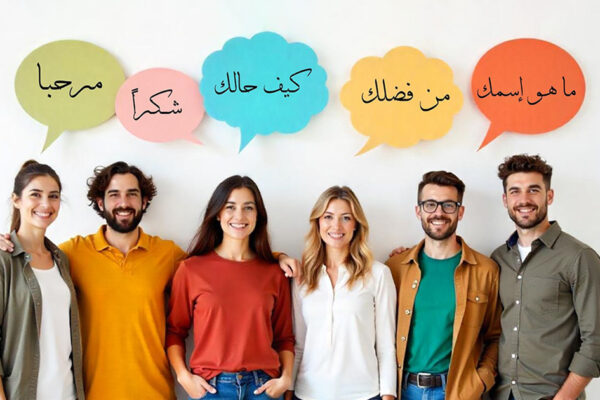
MSA: “كيف حالك؟” (Kayfa haluka?) | Levantine: “كيفك؟” (Kayfak?) | Meaning: “How are you?”
2- Gulf Arabic (Saudi Arabia, UAE, Kuwait, etc.)
Closest linguistically to Classical Arabic, with strong phonetic preservation of deep-rooted Arabic sounds.
Vocabulary often includes Islamic and Bedouin influences.
English and Hindi/Urdu loanwords are common due to large expatriate populations.
Cultural Notes: Spoken in business and religious settings, but slightly harder for non-natives to grasp due to tribal variations.
3- Maghrebi Arabic (Morocco, Algeria, Tunisia, Libya, Mauritania)
Highly distinct and often unintelligible to Eastern Arabs.
Includes many French, Berber, and Spanish loanwords, making it a linguistic fusion.
Syntax, pronunciation, and spoken pace differ sharply from MSA.
Fun Fact: Some Moroccans switch to French when speaking to Arabs from the Levant or Gulf due to mutual incomprehension.
4- Egyptian Arabic
Arguably the most recognized due to Egypt’s influence in cinema, music, and pop culture.
Shares about 80% of MSA’s vocabulary but alters grammar and phonology.
Commonly understood across the Arab world—even by those who don’t speak it.
Used in: Movies, songs, and everyday speech
Example Phrase:
MSA: “ماذا تفعل؟” (Maathaa taf’al?) | Egyptian: “بتعمل إيه؟” (Bit’amel eh?) | Meaning: (What are you doing?)
Linguistic Criteria: Dialect vs. Language
To determine whether dialects are separate languages, linguists use three main criteria:
- Mutual Intelligibility: If two speakers cannot understand each other, they may not be using dialects of one language—but two different languages. For example, a Jordanian speaker may struggle to understand Moroccan Arabic, even though both speak “Arabic.”
- Standardization: MSA is standardized and codified, while dialects are often informal, unwritten, and vary across cities—even within the same country.
- Political & Social Factors: Despite major differences, Arabic dialects are still viewed as “varieties of Arabic” due to religion, shared identity, and the role of MSA as an official language in 20+ countries.
How AlBaher Teaches Dialect Awareness?
At AlBaher Arabic Language Center, we recognize that students must engage with both formal and informal Arabic. Our curriculum builds awareness and fluency through hands-on activities:
Comparative Linguistics Module: Students compare modern standard Arabic (MSA) with dialects like Jordanian or Egyptian Arabic. We highlight how different Arabic words, sentence structures, and even greetings shift across contexts.
Dialect Mapping Exercises: We use interactive maps and role-play to:
- Show the geographical distribution of dialects
- Practice phrases in context (e.g., markets, cafés, airports)
- Help learners switch between formal Arabic and everyday spoken language
Final Thought
So—can we call the Arabic language dialects “languages” on their own? Linguistically, yes in some cases. But culturally and politically, they remain connected through MSA as a unifying standard. At AlBaher Arabic Language Center, we prepare you to navigate all forms of Arabic—spoken and written, standard and local—so you can thrive anywhere in the Arab world.
FAQ
Yes, remarkably well. The Levantine dialect—spoken in Jordan, Palestine, Lebanon, and Syria—is considered one of the most “transparent” and prestigious varieties. Due to the historical spread of Levantine media and its relative proximity to Modern Standard Arabic, speakers from the Gulf to North Africa can generally follow a conversation in Shami. It acts as a “linguistic bridge,” making it one of the most efficient choices for anyone wanting broad regional reach.
The “difference” usually comes down to historical layers. While Levantine Arabic was influenced by Aramaic and Syriac, Maghrebi dialects (from Morocco, Algeria, and Tunisia) incorporated Amazigh (Berber), French, and Spanish influences. Additionally, Maghrebi dialects tend to shorten vowels and use a different rhythmic pace. This is why a Jordanian and a Moroccan might switch to a “Middle Arabic” or simplified MSA to ensure they understand each other perfectly.
Absolutely. While they share a root system with MSA, dialects like Levantine have “streamlined” the language for efficiency. For example, the complex case endings of formal Arabic are dropped, and unique prefixes are added to verbs to indicate the present continuous tense (like the “b-” prefix in Bishrab – I am drinking). These aren’t “errors”; they are the evolved rules of a living, breathing language that prioritizes flow and connection over rigid formality.
In linguistics, there is an old saying: “A language is a dialect with an army and a navy.” Theoretically, if a dialect were to be standardized, used in all government documents, and taught exclusively in schools, it could be classified as a language (similar to how Spanish and Italian evolved from Latin). However, because the Quran and the vast body of Arabic literature are in MSA, there is a strong cultural desire to keep the dialects under the “Arabic” umbrella, preserving a sense of pan-Arab unity.
If you are looking for the “Golden Key,” the Levantine (Shami) dialect—specifically the urban Jordanian or Lebanese accent—is your best bet. It is widely regarded as the “softest” and most intelligible. It avoids the heavy glottal sounds of some regions and the complex “VSO” sentence structures of formal Arabic, allowing you to sound modern, educated, and relatable to almost any Arabic speaker you encounter.

You may also like

Learn Levantine Arabic Online or in Amman

Arabic Language Dialects: A Guide to Different Arabic Dialects